End Grain vs Edge Grain Cutting Boards: A Complete Comparison
End grain and edge grain cutting boards look different, perform differently, and cost different amounts. This guide explains why so you can pick the right one.
Quick answer: End grain cutting boards are more durable, gentler on knives, and self-healing. They cost more because they take significantly longer to build. Edge grain boards are more affordable, easier to maintain, and still perform well for daily cooking. Face grain is best for serving, not cutting.
If you are shopping for a quality cutting board or thinking about ordering a custom one, the first decision is grain orientation. End grain and edge grain are not just cosmetic differences. They affect how the board performs under a knife, how long it lasts, and how much it costs. We build both types at our workshop in Babylon, NY, and this guide covers everything you need to know to choose between them.
What is end grain?
Imagine a tree trunk. If you looked straight down at a freshly cut stump, you would see the rings. That is end grain. An end grain cutting board is made by cutting wood into blocks and standing them upright so the fibers point straight up. When you cut on the surface, the knife slips between the fibers rather than slicing across them. The fibers spring back after the cut, which is why woodworkers call it "self-healing."
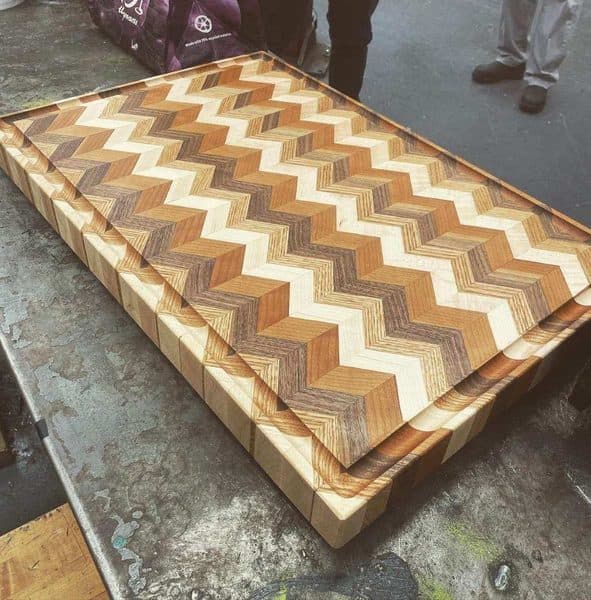
End grain boards are the ones with the distinctive checkerboard, brick, or mosaic patterns. Those patterns are not painted on. They come from arranging blocks of different wood species into geometric designs before gluing them together. The chevron board in the photo above is a good example. It uses maple, walnut, and cherry blocks arranged in a zigzag pattern.
What is edge grain?
Edge grain is what you see when you look at the narrow side of a board. Take a piece of lumber, flip it on its edge, and that is the surface you are cutting on. Edge grain boards are made by gluing strips of wood side by side with the edges facing up. The result is a cutting surface with long, parallel lines running the length of the board.
Edge grain boards are simpler to build. The wood does not need to be crosscut into blocks and rearranged. This is the main reason they cost less. They are still excellent cutting surfaces and are the most common type of board in professional kitchens because they are durable and easy to resurface.
What about face grain?
Face grain is the wide, flat surface of a board. It is what you see when you look at a plank straight on. Face grain shows the most dramatic grain patterns and looks beautiful. But it is the softest orientation, and a knife will scar it quickly. We recommend face grain for serving boards, charcuterie platters, and cheese boards. If the board is meant for display and light use, face grain is fine. For serious cutting, go with end grain or edge grain.
Side-by-side comparison
| Factor | End Grain | Edge Grain | Face Grain |
|---|---|---|---|
| Durability | Excellent (self-healing) | Very Good | Fair (scars easily) |
| Knife Friendliness | Best (fibers absorb impact) | Good | Poor (dulls knives faster) |
| Pattern Options | Checkerboard, brick, chevron, mosaic | Parallel stripes | Natural grain display |
| Maintenance | Monthly oiling | Monthly oiling | Monthly oiling |
| Weight | Heavy | Moderate | Light |
| Price | $$$ | $$ | $ |
| Build Time | 3-4x longer | Standard | Simplest |
| Best For | Daily cooking, gifts | Professional kitchens, daily use | Serving, display |
Durability and self-healing
The self-healing property of end grain is not marketing language. It is a physical characteristic of how wood fibers behave. When a knife pushes between vertically oriented fibers, the fibers separate and then spring back into position. On an edge grain board, the knife cuts across the fibers, leaving a permanent score mark. Over months and years of daily use, an edge grain board accumulates visible cut lines. An end grain board stays smoother because those cuts close themselves.
This matters for both appearance and food safety. Deep score marks can harbor bacteria. A smoother surface is easier to clean and sanitize. If food safety is a priority (and it should be), end grain has a genuine advantage.
Knife friendliness
End grain boards are measurably gentler on knife edges. Because the blade pushes between fibers instead of cutting through them, there is less resistance and less edge deformation on the knife. If you own good knives and want to sharpen them less often, end grain is the better choice. Edge grain is not harsh on knives by any means, but you will notice your blades hold their edge longer on end grain.
Maintenance
Both types need the same basic care: wash by hand with warm soapy water, dry immediately (never soak or put in the dishwasher), and apply food-safe mineral oil about once a month. End grain boards absorb slightly more oil because the exposed fiber ends drink it up. This is actually a good thing; it means the oil penetrates deeper and provides better protection.
The one maintenance difference: end grain boards are harder to resurface if they get badly damaged. Because the blocks are arranged in a pattern, sanding requires care to keep everything level. Edge grain boards can be run through a planer or sanded flat more easily. In practice, with regular oiling, most people never need to resurface either type.
Price differences and why they exist
An end grain board costs roughly two to three times as much as an edge grain board of the same size and wood species. The material cost is similar. The difference is labor. Building an end grain board requires crosscutting strips into blocks, arranging them into a pattern, gluing and clamping in stages, flattening the glued-up panel, and then repeating the process if the pattern has multiple layers. A complex end grain board like a chevron or chaotic mosaic design can take an entire day to glue up, plus additional days for drying and finishing.
Edge grain boards are simpler. Glue the strips together, flatten, sand, finish. A skilled woodworker can build several in the time it takes to complete one end grain board. If budget is a concern, edge grain gives you a quality hardwood board at a lower price.
Which should you choose?
If you cook daily and care about your knives, go with end grain. It performs better, lasts longer, and the patterns are genuinely beautiful. If you want a solid, reliable cutting surface at a more accessible price, edge grain is the right call. If the board is mostly for serving and display, face grain looks the best.
A lot of our Long Island customers order both. An end grain board for their main cutting station, and a simpler edge grain or face grain board for serving cheese, bread, or charcuterie when guests are over. That combination covers everything.
Order a custom cutting board
We build custom cutting boards in end grain, edge grain, and face grain with your choice of wood species, patterns, and personalization. Engraved names, epoxy resin inlays, team logos, family crests. Browse our gifts and specialty items page to see options, or check out the gallery for photos of boards we have built. When you are ready to order, call (516) 554-2734 or request a free quote.
Cutting Board FAQ
End grain is better for cutting. The exposed wood fibers act like a self-healing surface, absorbing knife impacts and closing up after cuts. This also keeps your knives sharper longer. Edge grain is still a good cutting surface, but it shows cut marks more readily.